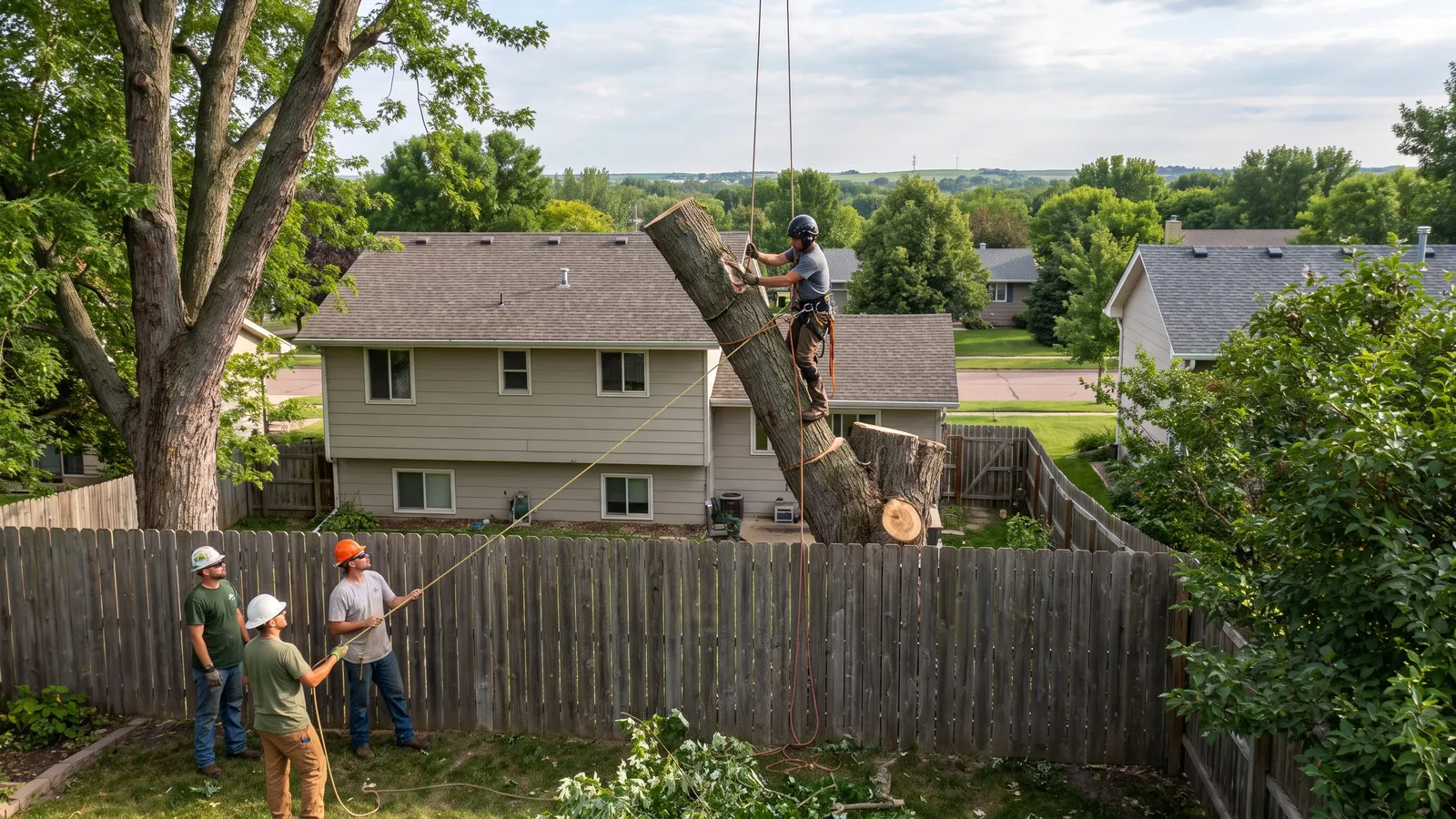
Ash gets most of the attention in Sioux Falls, and it has its own page: ash tree removal. The rest of our removal work is a mix of everything else the city planted. There are silver maples and cottonwoods that grew huge and weak-wooded over 50 years. There are Colorado spruce dying from the bottom up with Cytospora canker. There are American elms lost to Dutch elm disease, Siberian elms and boxelders that seeded themselves along fences, and trees of every kind that a derecho split, leaned or left hanging over a roof.
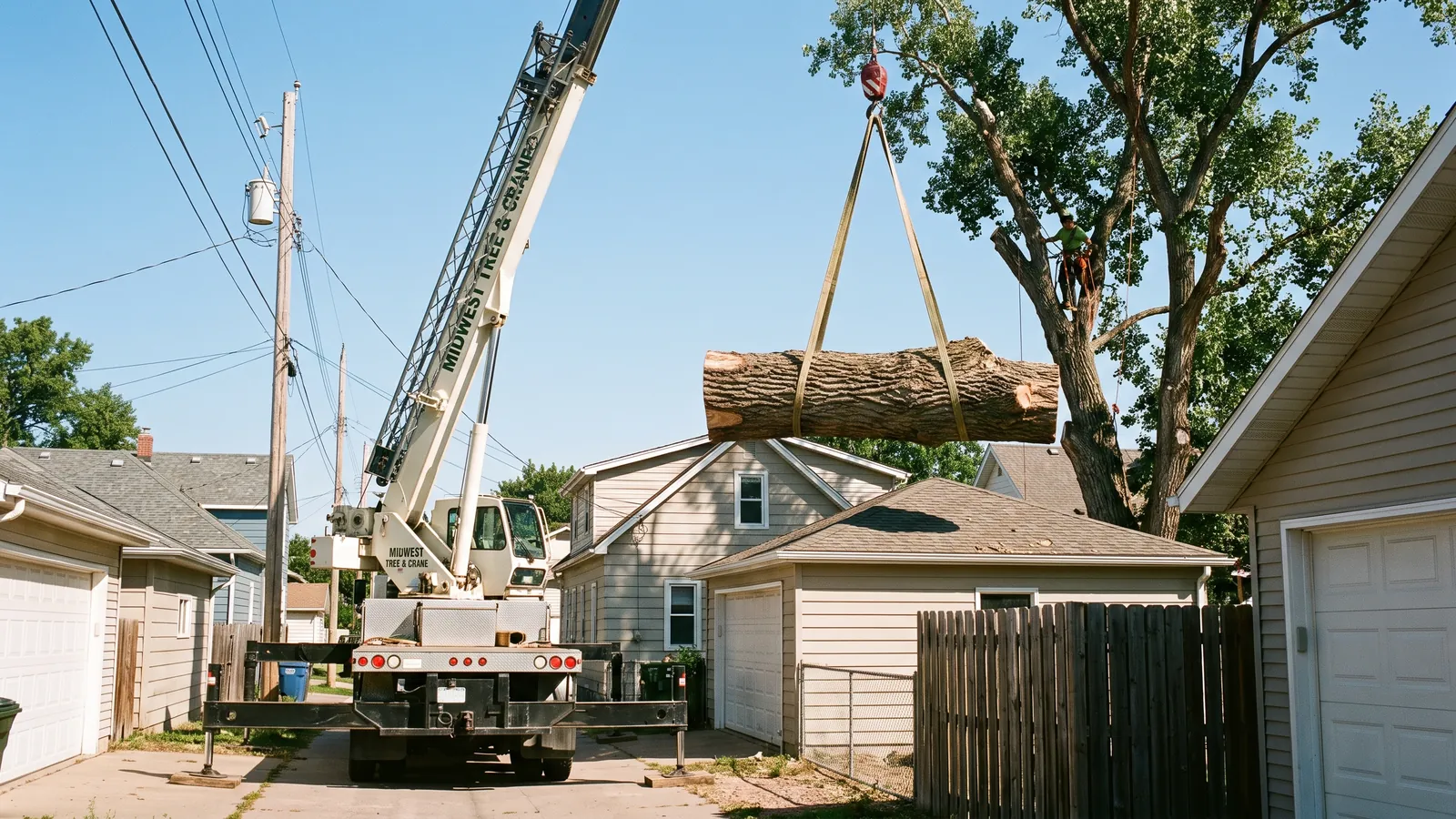
How it comes down depends on the drop zone. On an acreage in Harrisburg or Dell Rapids, a tree can sometimes be felled whole. On a 50-foot lot in the Cathedral District or around McKennan Park, with the house, the garage, the neighbor and the power line all under the canopy, it comes down in pieces. A climber or bucket operator takes the limbs and trunk in sections, each one roped and lowered by the ground crew so nothing lands on anything, and it all goes through the chipper. Where there's no room to lower pieces, we bring in a crane. Before we start we check for power lines. Xcel Energy and Sioux Valley Energy both say work near lines belongs to qualified line-clearance professionals, and Xcel will disconnect a service drop so a tree near it can be worked safely.
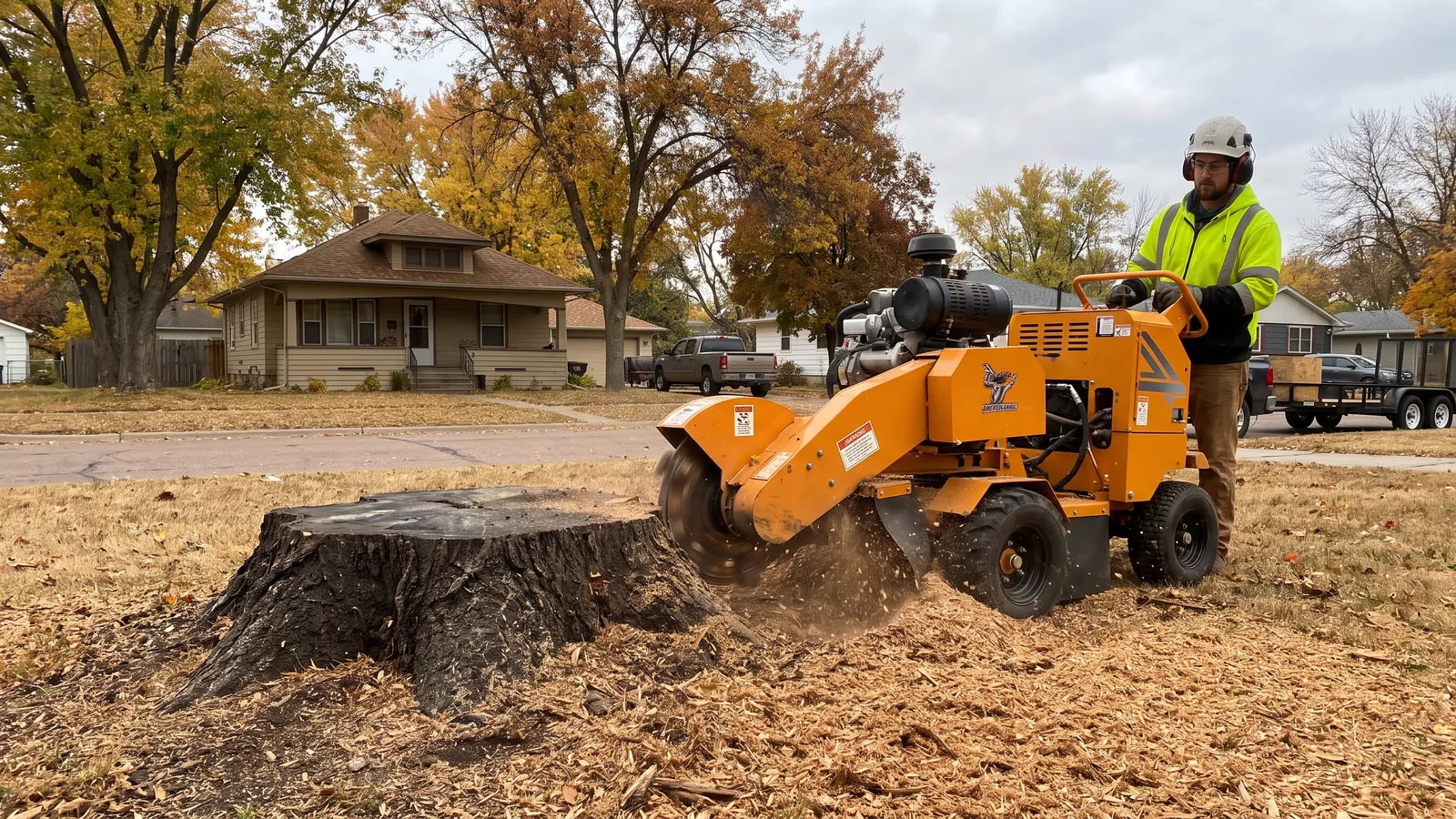
Inside Sioux Falls, anyone paid to remove a tree must hold a City arborist's license and carry liability insurance (Code § 94.060). A tree on your own property doesn't need a City permit to remove. A tree on the boulevard does, and the permit is free. The City requires the stump and major flare roots to be ground six to eight inches below grade. When we're done, the wood is chipped or hauled, the lawn is raked and the stump is ground if you want it.
What's included
Licensed and insured
City arborist's license and general liability, plus workers' comp, with the certificate before anyone climbs.
Rigged in sections
Limbs and trunk roped and lowered over roofs, fences and gardens, not dropped.
Power lines checked
Service drops coordinated with the utility; line-clearance work left to qualified crews.
Boulevard permits
The City's free removal permit for parking-strip trees, with the stump ground 6 to 8 inches below grade.
Chipped and hauled
Everything cut leaves with us, to the landfill's wood pile or as chips.
Straight answer
If a tree can be saved with pruning or treatment, we say so before we price a removal.
Tree removal cost in Sioux Falls, SD
| Job | Typical price | Notes |
|---|---|---|
| Small tree, under 30 ft | $300 – $700 | Open drop zone |
| Medium tree, 30–60 ft | $700 – $1,800 | Most maples, elms and spruce |
| Large tree, over 60 ft | $1,800 – $4,500 | Big cottonwoods and silver maples |
| Tree over the house, rigged in sections | + $300 – $1,200 | Depends on how much rigging |
| Crane-assisted removal | $2,500 – $7,500 | See crane removal |
| Stump grinding | $120 – $400 | Per stump, below grade |
| Haul-off | Included | Chipped or hauled to the landfill |
These are 2026 Sioux Falls ranges to help you budget. Your written price is itemized (climb or bucket work, rigging, chipping and haul-off, stump grinding, crane time) and good for 30 days.
Recent work
Questions we get about tree removal
Do I need a permit to remove a tree on my property?
Not from the City for a private tree. A tree in the boulevard (the parking strip between curb and sidewalk) needs the City's free removal permit, and the stump has to be ground 6 to 8 inches below grade.
Do you need to be licensed?
Yes. Sioux Falls requires a City arborist's license and general liability insurance for anyone paid to trim or remove trees in the city. The City publishes the list of licensed companies.
Can you take down a tree near power lines?
Near the service drop to your house, yes, after Xcel Energy disconnects or de-energizes it, which they'll do on request. Trees touching the main distribution lines are the utility's line-clearance crews' job. If a tree is on a line and sparking, call 911.
Will my lawn be wrecked?
We use mats where machines cross the lawn and rope pieces down rather than dropping them. You'll see some wear where the chipper and truck sat. We rake and clean up before we leave.
How long does it take?
Most residential removals are one day. A large tree over a house or a crane job may take a full day by itself.
What happens to the wood?
We chip it or haul it to the landfill's wood pile, where limbs and branches are ground into mulch. Ash wood stays inside the quarantine counties.